For best men, maids of honor, fathers, mothers, siblings and friends who said yes

If you can answer 12 questions about the couple, you already have the first draft of your toast.

$27 · one-time payment
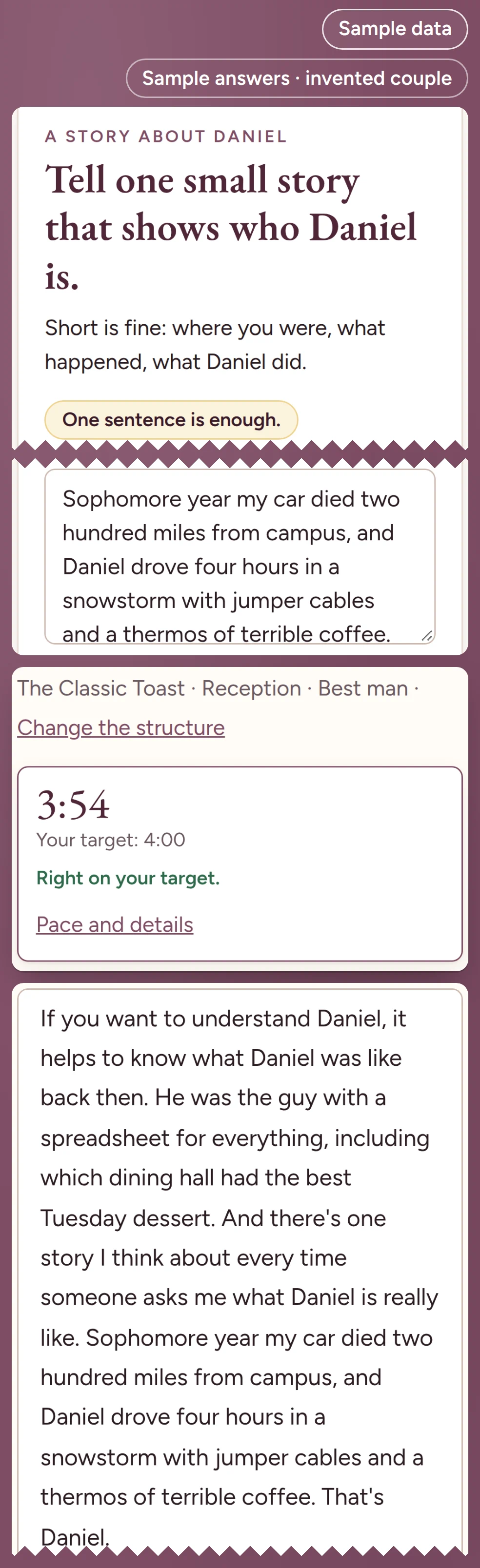
The Toastwright Speech Builder: a question on the left, the draft and the reading-time counter on the right

Screen from the builder, with sample answers for an invented couple.

Answer 12 questions about the couple and get a speech draft built from your own stories, in one of 6 structures, with a reading-time counter set to the 3, 4 or 5 minutes you pick. Ready to edit and print as cue cards. For the engagement party, the rehearsal dinner or the reception.

Here's one answer going in. An invented best man typed this for question 3:

"Sophomore year my car died two hundred miles from campus, and Daniel drove four hours in a snowstorm with jumper cables and a thermos of terrible coffee."

In his draft, in The Classic Toast, it comes out like this:

"And there's one story I think about every time someone asks me what Daniel is really like. Sophomore year my car died two hundred miles from campus, and Daniel drove four hours in a snowstorm with jumper cables and a thermos of terrible coffee. That's Daniel."

His sentence, word for word, terrible coffee and all. The two short lines around it come from the structure.
8:40 p.m. The blank page

You said yes three weeks ago. Saying yes took two seconds. Someone asked you to stand up at their wedding and say something about them, and of course you said yes.

Now it's 8:40 on a Tuesday, the rehearsal dinner is in eleven days, and the document on your screen is still blank. The cursor seems to be having a nice evening.

You've read a few toasts online. They were fine. They were about two people you've never met: the jokes would fit any couple, and the stories belong to someone else.

You know this couple. You have years of them. What you don't have is a first line, or any idea how long a toast actually runs when you're the one holding the glass.

So is the problem that you don't have good stories? If you know this couple, you have stories. What's missing is order and length: which story goes where, and how much of it fits. Starting with the first sentence makes it worse, because the first sentence has to know where everything else is going.

Illustration: a blank document with a blinking cursor at 8:40 p.m.

Illustration.

8:46 p.m. Three choices, no writing yet

Open the builder and pick three things:

  1. The occasion: the engagement party, the rehearsal dinner or the reception.
  2. Your role: best man, maid of honor, father of the bride or groom, mother of the bride or groom, sibling, or friend.
  3. How long you want to talk: 3, 4 or 5 minutes.

The same screen asks for three first names (yours, the person you know best and their partner) and how you'll introduce yourself, so the draft can use them. You haven't written a word, and you're already further along than the blank page.

8:50 p.m. Question 1

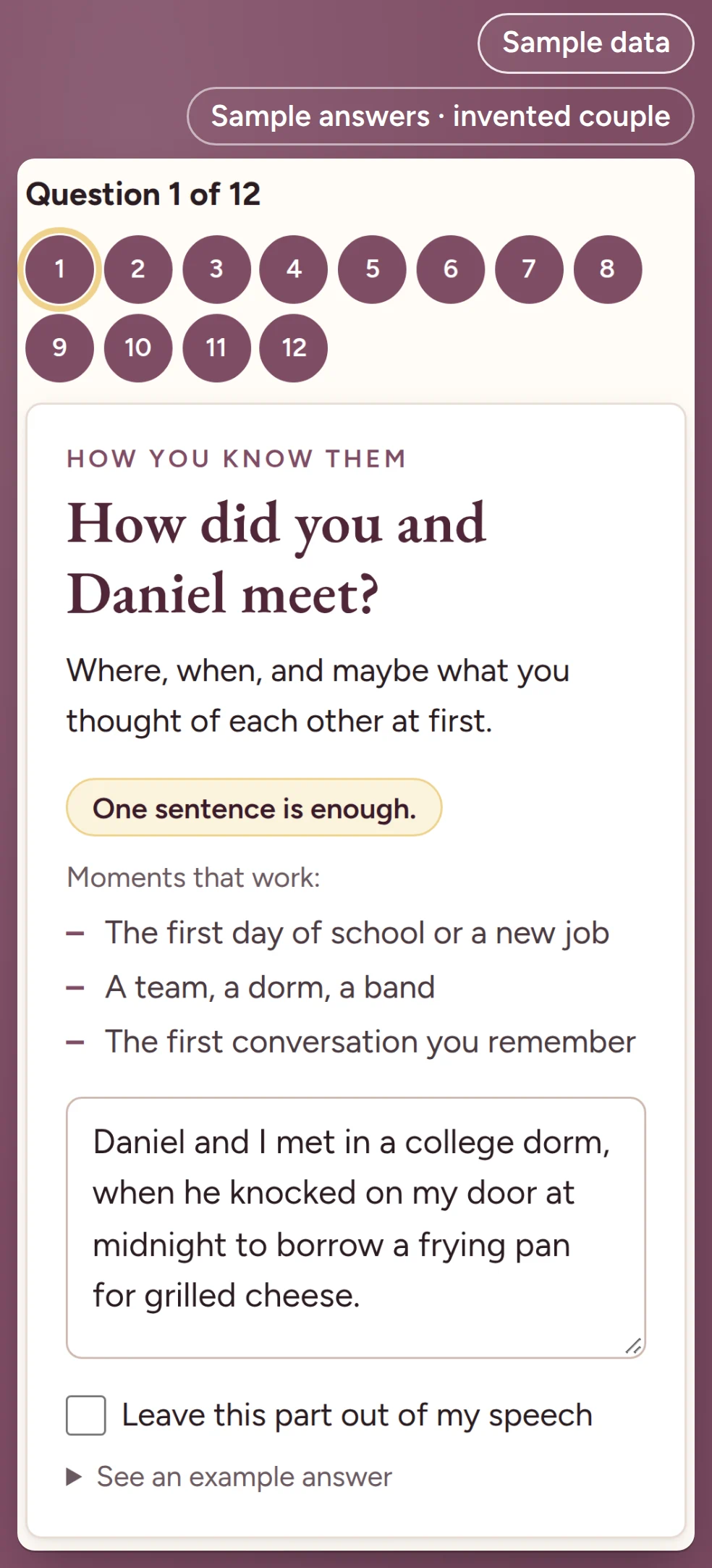
The builder asks 12 questions, one at a time. Each one comes with a hint and a few kinds of moments that work, and each one tells you the same thing: one sentence is enough.

The questions ask for small, true things, the kind you'd tell a friend over a drink. If you've been telling yourself you don't have any good stories, start with a small one. Small ones work.

One everyday-length sentence per answer is enough for a whole draft, and it comes to three minutes and change at the builder's standard pace of 115 words a minute. Picked 4 or 5 minutes? The two story questions ask for two or three sentences, and if the draft still comes in short, the counter says by how much and suggests a detail for one of your stories.

Your answers save as you go. If you stop at question 7 to answer the group chat, question 8 will be right there when you come back.

A question in the builder with its hint and "One sentence is enough", sample answer typed in

9:20 p.m. Question 12, and one of 6 structures

Twelve answers in. Now the builder asks how you want the speech to go.

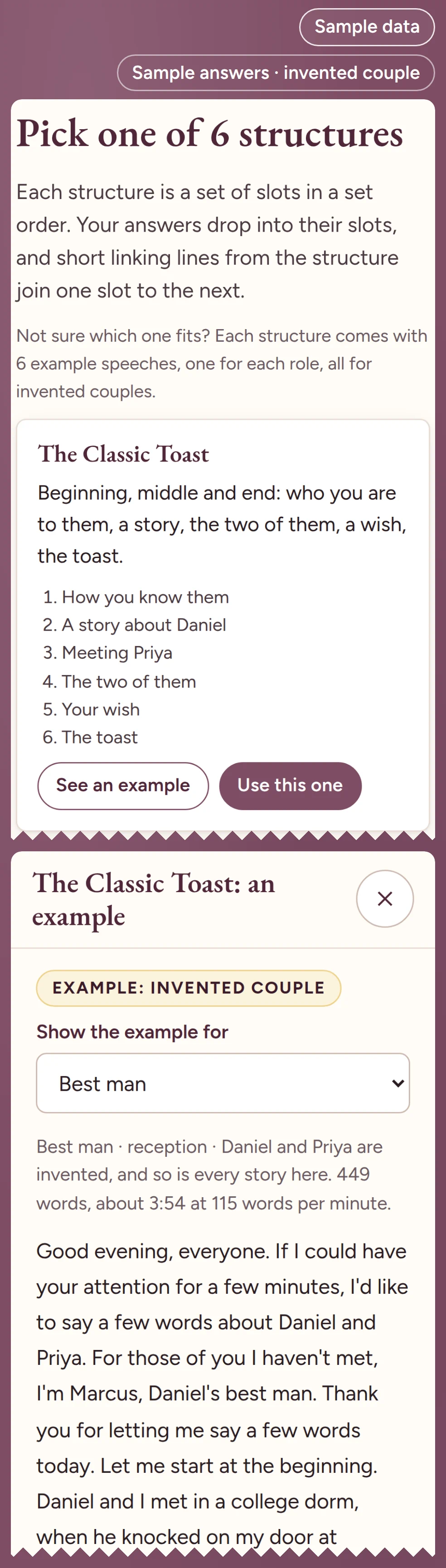
There are 6 structures. Each one is a set of slots in a set order, such as the opening, how you know the couple, the story, what you admire about them, your wish for them, and the toast itself.

Not sure which one fits? Each structure comes with 6 example speeches, one for each role, so there are 36 in all. Every one of them is written for an invented couple, and says so at the top.

The 6 structures to choose from, with an example speech open and marked "Example: invented couple"

9:24 p.m. Story Slot Assembly

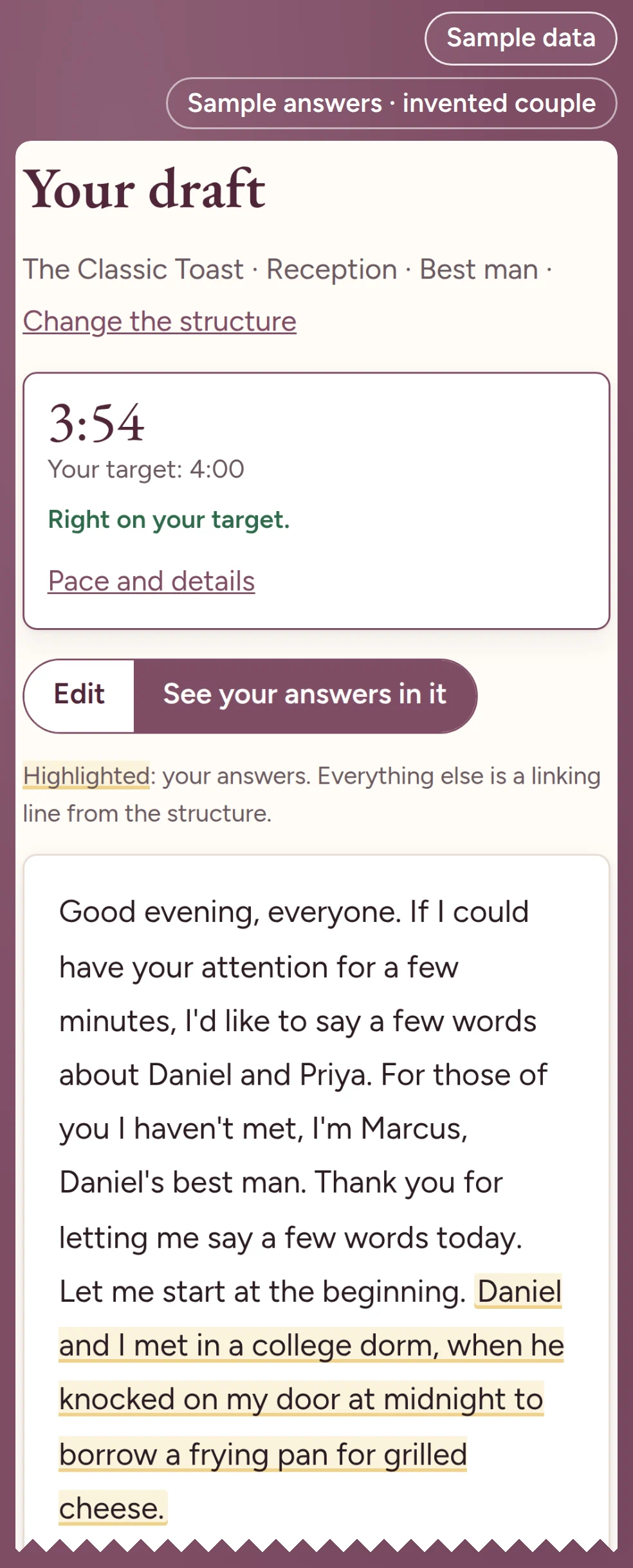
Here's what happens when you pick one. Each of your answers drops into its slot in that structure. Short linking lines from the structure join one slot to the next, so the draft reads like a speech and not like a list of answers.

Every line in the draft comes from your answers or from those linking lines. The builder doesn't make anything up. If you left a question blank, it asks you for the answer instead of filling the gap, unless you mark that part to leave out.

In the corner, the reading-time counter adds up the words and divides them by your speaking pace. Set the pace slower or faster, and the counter follows. If it says 5:40 and you wanted 4, you know to trim before you rehearse, not after.

Then you edit right there: cut a line, swap a word, move the joke to the end. The counter keeps up as you go.

The draft with the sample answers highlighted inside it, and the reading-time counter in the corner

Screen from the builder, with sample answers for an invented couple.

What the builder won't do, even if you ask nicely

It's built for whoever ends up holding the glass: the best man, the maid of honor, the father of the bride or groom, the mother of the bride or groom, a sibling or a friend, at the engagement party, the rehearsal dinner or the reception. A few jobs stay with you:

And if you barely know the couple, the questions won't have much to work with.

9:50 p.m. Out loud, then on paper

Read it out loud, even if it's only to the dog. You'll hear the line that needs a breath and the one that needs to go.

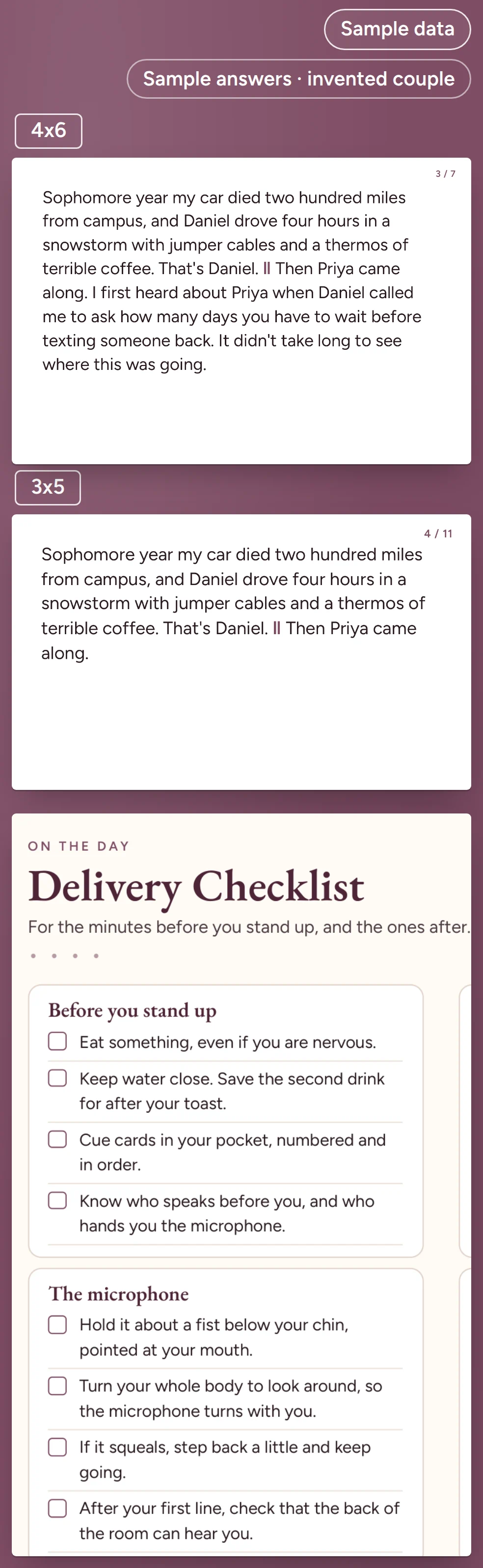
Then print it two ways: the whole speech on one page, and cue cards in 3x5 or 4x6, with pause marks where you'll want them. On the day, the cards are in your pocket, and the stories on them are yours.

The Delivery Checklist goes with them: one page on the minutes before you stand up, the microphone, the glass, your pace, and what to do if you lose your place.

Cue cards with pause marks, printed in 3x5 and 4x6, next to the one-page Delivery Checklist

10:05 p.m. No Speech Required

If the draft doesn't help, you don't have to explain why. Email us within 30 days of your purchase.

30-day money-back guarantee: email support@toastwright.site within 30 days of your purchase and you'll get a full refund of that purchase.

In your pocket on the day

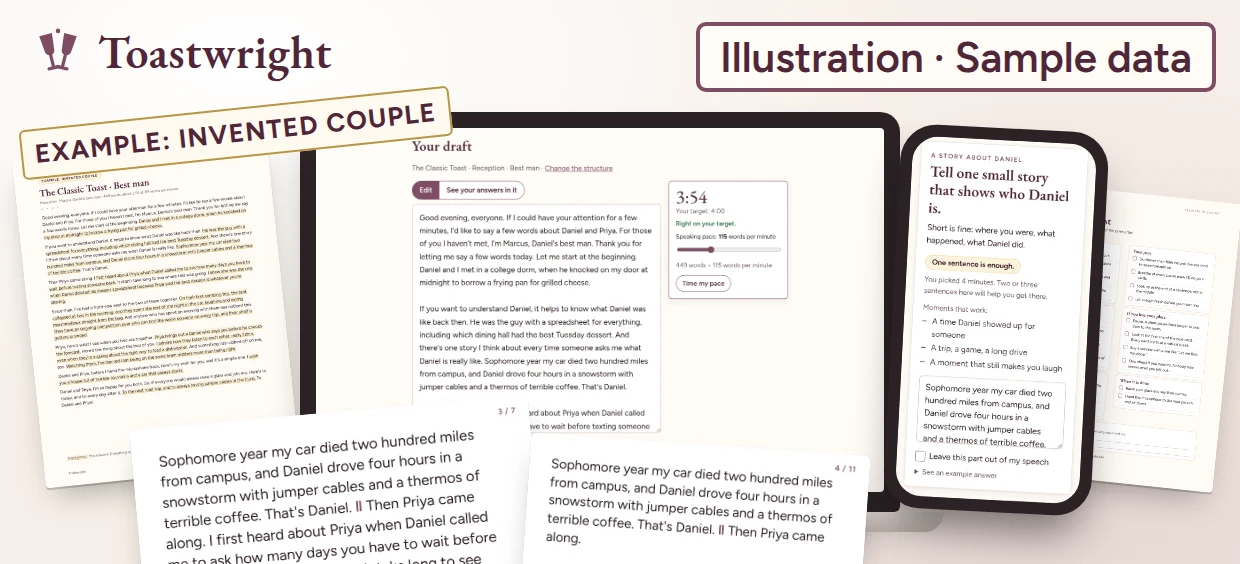
The Toastwright Speech Builder on a laptop and a phone, with printed cue cards, an example speech and the Delivery Checklist

The Toastwright Speech Builder — $27 USD, one-time payment

  • The builder (web app): occasion, role and length; 12 questions with hints; 6 structures; a reading-time counter with a pace you can adjust; editing right in the draft. Your answers save as you go.
  • Cue cards and print: your speech as cue cards in 3x5 or 4x6, with pause marks, or the full text on a page.
  • 36 example speeches: 6 roles times 6 structures, each one for an invented couple and marked as an example.
  • Delivery Checklist: one page for the day itself.
  • Quick Start: one page to get you to question 1.
  • Email help for 12 months: support@toastwright.site, with a reply within 2 business days.

Access doesn't expire, so the builder is there for the next toast, too. If we ever stop offering the builder, we'll email you at least 60 days before, so you can print or copy your speech and download the PDFs.

$27 · one-time payment

One-time payment. No subscription.

The sign-in link goes to the email you check out with.

Payments run through Auryon369 (Fracktal Technologies LLC), our merchant of record. A refund is issued by Auryon369 or by us. Something to ask first? Email support@toastwright.site.

Fair questions, quick answers

Does it write the speech for me?

No. You answer the questions; the builder puts each answer in its slot and joins them with short linking lines. Without answers, there's no draft.

Will it sound like me?

The stories, the names and the details are yours, in your words. The linking lines come from the structure, and you can rewrite any of them.

I don't have funny stories. Do I need them?

No. The questions ask for small, true things, and one sentence per answer is enough to start. Funny is optional. True is the part that counts.

Can't I just ask a chatbot for a speech?

You can, and you'll get a speech. It won't know the story about the canoe, because only you do, and it may fill the gaps with things that never happened. Even with the canoe story, it can add details you never gave it. The builder uses only what you give it, puts each piece in its slot and shows you how long the whole thing runs.

How long does it take?

That depends on how long you think about each answer. Your answers save as you go, so you can do it in one evening or spread it over a few.

Is it only for the reception?

No. You pick the occasion first: the engagement party, the rehearsal dinner or the reception.

What if I blank on the day?

We can't promise you won't. We can make sure the next line is in your hand: the cue cards have your speech with pause marks, and the Delivery Checklist covers what to do if you lose your place.

Do I need a printer?

To print the cue cards, a home printer or a print shop works. You can also read the full text from your phone.

Where is my speech saved?

In your browser, on the device you write on. You can print the full text or the cue cards any time.

Will I be charged again later?

No. It's $27, once. Access doesn't expire.

Question 1 needs one sentence

Start with question 1 tonight. Answer the twelfth, pick a structure, and the draft is there to read out loud.

$27 · one-time payment

P.S. You said yes because you know them, which means the stories already exist. The builder's job is the order and the clock.